
Every hour of administrative tasks you take off a clinician’s plate is better care and better economics at the same time.
I’ve believed one thing since I started in healthcare operations: reducing physician administrative tasks so the physician can just be a physician.
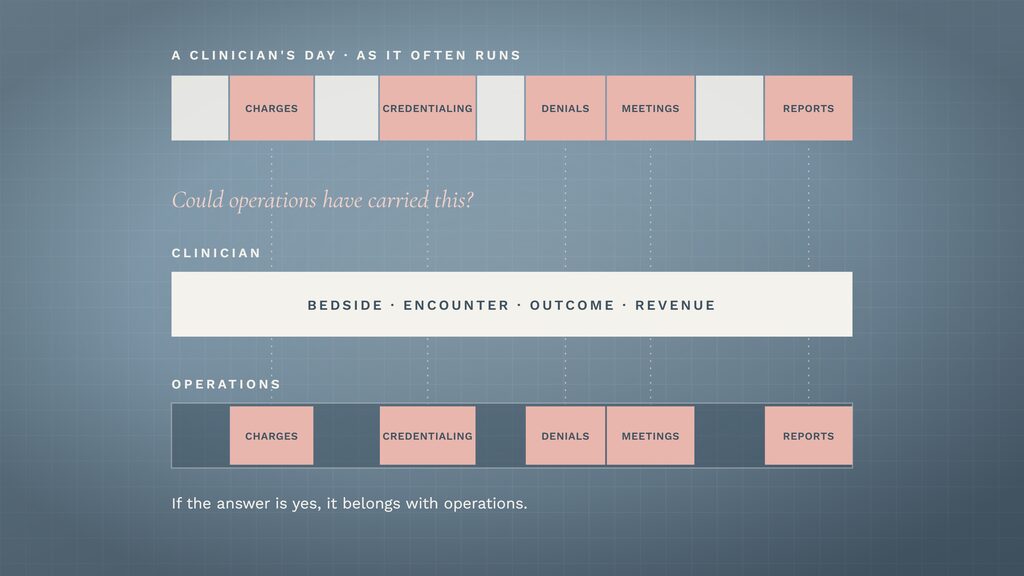
As a former nurse practitioner, I’ve been on the other side of it, pulled away from patients by work someone else could have carried. So this isn’t theory for me. I know what it feels like to have your attention taken from the person in front of you by a task that never needed to be yours.
Everything else, the charge capture, the credentialing, the denials, the meetings, the reports nobody reads, that’s mine. Not theirs. When a physician, NP, or PA is doing that work, you’ve taken your most expensive, most highly trained resource and pointed it at your lowest-value tasks, and pulled it away from the one place it creates value: the bedside.
Why this is an economics problem, not just a wellness one
People frame this as burnout. That’s real, but it undersells it. This is an operating strategy.
A clinician at the bedside generates the encounter, the outcome, and the revenue. A clinician fighting a denial generates none of the three. So when administrative work migrates onto a clinician’s plate, you’re not just risking their wellbeing, you’re taking your highest-value asset offline and pointing it at work a lower-cost resource could have handled. Every hour of admin you take off their plate is better care and better economics at the same time.
Too many organizations treat physician administrative tasks as a wellness issue to address when there’s time. It’s actually a daily hit to both quality and margin. The most expensive, most highly trained person in the building spends part of every day on work a lower-cost resource could have handled. That’s not a scheduling inconvenience. It’s a flaw in how the operation was built, and it costs you every day it goes unaddressed.
The test I hold every tool to
It’s also the standard I hold every technology to: does this let the physician just be a physician? Because I practiced, I can see it immediately. When I look at a tool or a process, I know what a real clinician’s day feels like, so I can tell when something is quietly going to add to it, no matter how smooth the demo runs.
If a tool adds clicks, or quietly moves work onto the clinician, it fails, no matter how good the demo looked. I’ve watched organizations buy technology that was supposed to reduce burden and instead shifted it, adding steps to the clinician’s day in the name of efficiency somewhere else in the system. A tool that makes the operation more efficient by making the clinician’s day harder isn’t a win. It’s a cost transfer, and the clinician is paying it.
The right tools do the opposite. They absorb work invisibly, so the clinician’s day gets simpler, not more complicated.
Own the load completely
So I’ve spent my career on the other side of that trade. Own the operational load so completely the clinician barely knows it exists. That means building the systems, the staffing, and the workflows so the administrative work is handled before it ever reaches a physician administrative task list, not cleaned up after.
The goal isn’t a lighter admin burden for physicians. It’s no admin burden that operations could have carried instead. There’s a difference. “Lighter” accepts that clinicians will still carry some of the work that was never theirs to begin with. The higher standard is to ask, for every task on a clinician’s plate: could operations have carried this? If the answer is yes, it belongs with operations, not the clinician.
If your clinicians are still doing work your operations team could absorb, that’s the gap I’d close first.