
The bonus pool keeps growing. The share of plans reaching it keeps shrinking. For provider groups in value-based arrangements, the difference comes down to operational execution — and to the plan you partnered with.
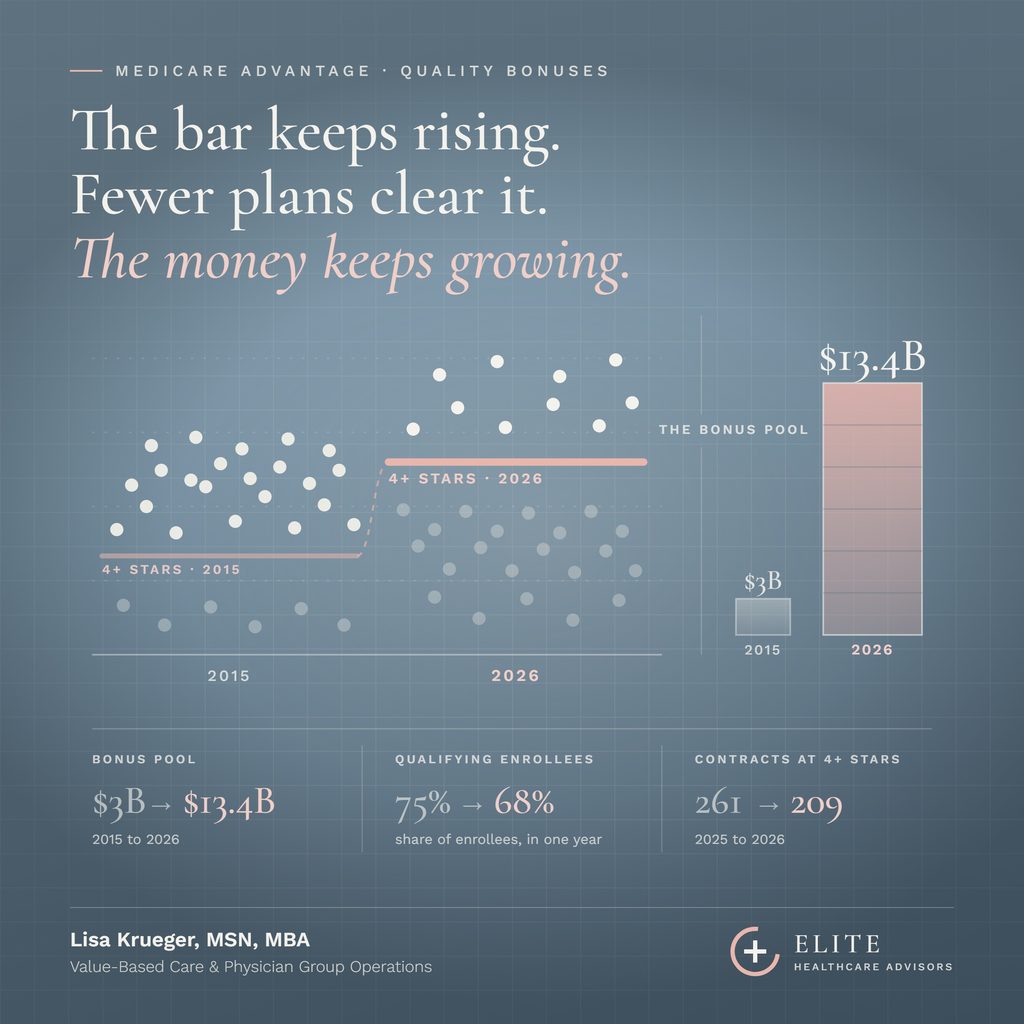
KFF put out a number recently that’s worth a closer look. Medicare will spend $13.4 billion on Medicare Advantage quality bonuses in 2026, more than four times what it spent in 2015.
But the more interesting number is this: the share of enrollees in plans that qualify for those bonuses dropped from 75% to 68% in a single year — the lowest since 2018. So the pool of money is growing while the number of plans reaching it is shrinking. The dollars aren’t spreading out. They’re concentrating, in fewer, higher-performing plans.
Those star ratings, and those bonus dollars, belong to the plans, not to provider groups. So it would be easy to read this as an insurer story, not a provider one. But for any group in a value-based, shared-savings, or capitated arrangement with a Medicare Advantage plan, the plan’s performance flows straight into your own economics. And that makes the concentration matter more than it might look.
Your own quality performance is the obvious piece — cancer screenings, chronic-condition management, the documentation that captures it. That’s the operational work you control, and most groups put their energy there. They should. But it’s only the starting point. Underneath it are a few harder questions.
Are you racing a moving field, or meeting a fixed bar?
Most groups treat quality performance as a fixed target: hit these numbers, earn the bonus. But that’s not how it works. CMS sets the threshold — the cut points a plan has to reach for four-plus stars — relative to how all plans perform, and recalculates it every year. As the field improves, the bar climbs.
So you can genuinely improve, perform better than you did last year, and still fall short, because everyone else improved faster. The proof is in the numbers: only 209 contracts cleared four-plus stars in 2026, down from 261 the year before. It isn’t a standard you meet once. It’s a race you’re either gaining ground in or losing.
When the bar was lower, decent operations cleared it. On a rising curve, decent isn’t enough.
Is the plan you partnered with lifting its whole network, or just measuring it?
Here’s the part that catches provider groups off guard. Star ratings are set at the plan’s contract level — aggregated across every provider group that plan works with. So your upside doesn’t depend only on how well you perform. It depends on how well the plan performs as a whole, which means it depends on the other groups in that plan’s network, and on whether the plan is doing the work to lift the entire thing.
Is the plan sharing performance data, closing gaps, aligning incentives, giving its groups what they need to succeed? Or is it collecting the bonus off the groups that perform while doing little for the ones that don’t?
Because if you’re carrying quality risk with a plan, you’ve tied part of your economics to provider groups you don’t control and may never meet — all pooled under one rating. You can run an excellent group and still miss the bonus, because the plan didn’t manage its network well enough to clear the bar.
Most groups scrutinize their own quality infrastructure before signing a value-based contract. Far fewer scrutinize whether the plan is actually built to help its groups perform, versus just measure them.
Are you getting a fair share, or subsidizing the plan’s bonus?
This is the one worth pressing on hardest. A large share of what earns a plan its stars — the screenings, the chronic-condition management, the documentation and capture — happens at the provider level. The plan can’t generate those numbers on its own. It depends on its groups to deliver and document the care.
So if your group is delivering the quality that earns the plan its stars, are you capturing a fair share of that reward? Or are you doing the operational work while the plan captures the bonus?
The star belongs to the plan. The effort often belongs to you. That’s worth examining in the terms of your contract, not just assuming.
It’s an operations problem, not a strategy problem
None of this is hard at the level of strategy. Everyone wants the quality performance. Everyone wants the bonus.
The hard part is operational — and relational. It’s whether your operations can actually execute on quality, consistently, across your whole population, as the bar keeps rising. It’s whether the plan you’ve partnered with is genuinely working to lift its network or just riding the groups that carry it. And it’s whether your contract pays you fairly for the quality your operations produce.
As CMS keeps tightening the cut points and the money keeps concentrating in fewer plans, the gap between the groups that perform and the ones that don’t will only widen. The organizations that keep winning won’t be the ones with the best strategy decks. They’ll be the ones built to execute on quality — and thoughtful enough to have partnered with plans and signed contracts that actually reward them for it.
If your group is carrying quality risk in a value-based Medicare Advantage arrangement but the performance, or the payoff, isn’t where it should be, the gap is usually operational. Finding where quality execution breaks down, and building the visibility to manage it, is the kind of work I do.