
Every few months a new report comes out naming the biggest barrier to value-based care. This year’s version lands on the same thing it always does, just said a little more plainly: physician adoption.

The finding is that clinicians trained under fee-for-service resist the new workflows, and that change management matters as much as the platform you bought to enable it. I’ve watched this play out enough times to believe it completely.
Why teams don’t move
Here’s what I’ve learned about why teams don’t move: it’s almost never that they don’t care.
It’s that the goal was handed to them as a mandate instead of translated into something that makes sense at the point of care. “We’re taking on risk” is a boardroom sentence. It means nothing to a physician at 2pm on a Tuesday with a full panel. The strategy is sound, the contract is signed, the platform is purchased — and then the whole thing stalls, because the people expected to change were never given a version of the change that fit the reality of their day.
This is the gap I see most often. Leadership talks about value-based care in the language of contracts, risk, and population health. The clinician experiences it as one more thing added to an already full day, with no clear connection to the patient in front of them. Both are right. The disconnect is in the translation.
What alignment actually looks like
The groups that get alignment don’t lead with the contract. They lead with the workflow. A few things they do differently:
- They lead with the workflow, not the contract. The clinician doesn’t need to understand the risk model. They need to understand what to do differently, and why it’s better.
- They make the new way easier, or at least clearer, than the old way. Change that adds friction gets abandoned. Change that removes it gets adopted.
- They connect the change to the specific patient. Not “we’re managing population risk,” but “this patient in front of you benefits from this specific thing.”
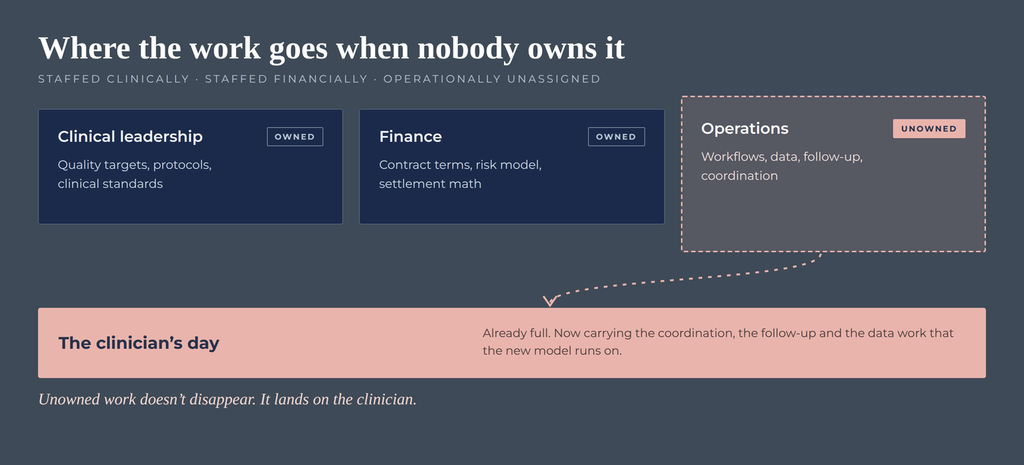
- They put someone accountable for the operational side, not just the clinical side. Value-based care has an operational dimension — workflows, data, follow-up, coordination — and if no one owns it, it falls back on the clinician, who doesn’t have time for it.
That last point matters more than people expect. Most value-based care initiatives are staffed clinically and financially, but is often left unowned. And unowned work drifts onto the clinician’s plate, which is exactly where it fails.
The real work
Value-based care doesn’t fail because physicians won’t change. It fails when nobody does the unglamorous work of making the change make sense — translating the boardroom strategy into something that works at 2pm on a Tuesday, and putting someone in charge of the operational reality, not just the clinical goal.
The technology and the contracts are the easy part. They’re buyable. The hard part — the part that actually determines whether value-based care works — is the human and operational work of alignment. And that work is where I spend my time.
If your organization has the value-based contracts and the technology in place but adoption keeps stalling, the problem probably isn’t the physicians. It’s in the translation, and the operational work underneath it. That’s the kind of thing I help groups fix.